
By Ben Thompson September 15, 2026
A proper food truck festival sales reconciliation does not start by comparing your three-day POS total with the first deposit that appears in your checking account.
A Friday-through-Sunday festival can create several separate timelines: the day customers bought food, the POS business day, the processor batch date, the day offline transactions uploaded, the processor funding date, and finally the date money appeared at the bank.
That distinction answers the most important question immediately: if your truck recorded $18,000 of weekend card activity but the bank deposits do not add up to $18,000 on Monday, that does not automatically mean money is missing.
Friday, Saturday, and Sunday transactions may settle through separate merchant batches and funds on different business days. Tips, refunds, processing fees, organizer commissions, held funds, delayed transactions, and offline payments can further change either the timing or amount of each deposit.
The safest festival payment reconciliation method is therefore to work day by day and batch by batch:
POS event-day sales → processor batch → settlement adjustments → expected processor funding → bank deposit.
Only after those records have been matched should an unexplained difference be treated as a genuine deposit variance.
This guide focuses specifically on festival closeout: how to follow three days of card activity through weekend batching, organizer deductions, offline queues, processor funding, and the bank without confusing normal timing differences with missing money.
Food Truck Festival Sales Reconciliation: Why the Weekend Total Does Not Match the Bank
Ordinary daily sales reconciliation is already more complex than comparing a register total with a bank balance. A festival adds another layer because high-volume sales may occur late at night, across several devices, through unreliable connectivity, and under a vendor contract that can require an organizer revenue share.
That is why food truck festival sales reconciliation should be organized around three independent records:
- What the POS says customers paid.
- What the processor says was submitted and settled.
- What the bank says was deposited.
Those figures may ultimately reconcile, but they do not necessarily belong to the same date.
Imagine your truck sells until 11:30 p.m. Friday. Your POS may consider everything from Friday service part of Friday’s business day. The payment processor, however, may use a batch cutoff that places some late transactions into another settlement batch.
If connectivity fails for part of Saturday night, several card payments may also remain queued until Sunday morning. Those payments belong operationally to Saturday but may appear in a later processor batch.
Then the vendor agreement may require a percentage of defined event sales. Depending on the agreement, that percentage might be invoiced later, paid separately, or withheld through a centralized event-payment arrangement.
Each change creates a legitimate difference between gross event sales and cash arriving at the bank.
A useful mental model is:
Sales date is not necessarily batch date.
Batch date is not necessarily funding date.
Funding date is not necessarily bank-posting date.
Current Toast reporting shows why festival reconciliation should keep sales activity, settlement, and funding separate. Its Payments Reports documentation includes card deposits, processing fees, chargebacks, invoices, and related financial activity, giving operators a processor-side record to compare with POS sales and bank funding.
That is the level of detail a festival reconciliation needs.
Batch Settlement for Food Trucks Over a Friday-Sunday Event

The phrase batch settlement food truck operators encounter in processor documentation refers to the process of grouping transactions for submission and settlement. It is important not to confuse that process with the moment a customer taps a card.
At a high level, a normal card transaction passes through stages.
First, the customer presents the card or wallet and the transaction is authorized. Authorization is essentially the approval stage.
Later, authorized transactions are captured and grouped for settlement according to the POS, gateway, processor, or acquiring arrangement being used.
Finally, funds move through the processing system and the processor or payment provider initiates funding to the merchant’s bank account.
Those stages can occur on different dates.
A festival operator therefore should not record:
Saturday card sales = Saturday bank deposit.
Instead, the reconciliation should preserve the relationship:
Saturday event-day card activity → corresponding processor batch or batches → resulting funding transaction or transactions.
This distinction becomes especially important during a batch settlement food truck review after a multi-day event because one day of POS activity does not always map neatly to one processor deposit.
Batch Date vs Funding Date vs POS Business Day
A POS business day is an operational concept. It tells you which service period a transaction belongs to for restaurant reporting.
A processor batch is a payment-settlement concept. It groups transactions submitted for settlement.
A funding date represents when the processor initiates or records the payout associated with settled activity.
The bank posting date represents when that money becomes visible in the merchant’s bank account.
Those dates may line up. They also may not.
The POS may close a business day after midnight while still assigning late-night sales to the prior service date. A processor cutoff could group those transactions differently.
Some platforms explicitly provide reports that separate the sales date from the settled date for this reason. Toast’s current payment reporting, for example, includes both sales-date and settlement information and provides reports for pending batches, settled batches, processing fees, refunds, withholdings, chargebacks, and payouts.
Operators using another processor should obtain the equivalent documentation and verify the specific batch cutoff and funding schedule that apply to their account.
The same principle applies whether your truck uses one countertop terminal, handheld readers, a tablet-based POS, or several devices.
Friday-Sunday Batch Timing
Consider this simplified event pattern.
Friday: Customers buy food throughout the event. Friday card transactions are captured and the applicable Friday batch closes. Funding follows according to your processor’s cutoff, settlement schedule, bank, and account configuration.
Saturday: Saturday transactions are captured into the applicable batch or batches. Weekend funding behavior may differ by processor, banking arrangement, and cutoff.
Sunday: Sunday transactions close into another batch. Depending on the processor schedule, upload timing, batch cutoff, and bank processing, related funding may become visible Monday, Tuesday, or another applicable business day.
Those are workflow examples, not guaranteed payout dates.
Before festival season, confirm the actual settlement schedule for your merchant account rather than assuming “next-day funding” means every calendar day under every circumstance.
Table 1: Illustrative Weekend Batch Timeline
| Event Day | POS Close | Batch ID | Expected Funding Window | Actual Bank Deposit |
| Friday, June 12 | Friday business day closed | FRI-101 | Per processor schedule | $3,980 |
| Saturday, June 13 | Saturday business day closed | SAT-102 | Per processor/weekend schedule | $6,910 |
| Sunday, June 14 | Sunday business day closed | SUN-103 | Per processor/weekend schedule | $4,760 |
| Sunday offline activity | Uploaded after reconnection | SUN-104 | Later settlement cycle | $620 |
The dates and amounts above are hypothetical. The purpose of the table is to show why the first Monday deposit should not automatically be compared with the entire festival total.
Batch Cutoff Times Matter
A common source of apparent shortages is the batch cutoff.
Processor, gateway, or POS capture rules may not follow calendar midnight. Transactions completed late in the evening may therefore settle in a different batch than the operator expects.
Do not insert a guessed cutoff into your reconciliation.
Instead, record the actual configuration shown by your processor or POS and preserve it with your festival accounting procedures.
A reliable mobile POS setup that keeps event sales and payment records organized by service period makes this process considerably easier, especially when several devices are operating at once.
Why Card Sales and Bank Deposits Are Different

The card sales vs bank deposit difference is one of the most misunderstood parts of festival bookkeeping.
Gross card sales measure customer payment activity. A processor deposit measures cash that has actually moved through settlement after whatever deductions, adjustments, timing rules, or holds apply.
Those are different measurements.
A general reconciliation framework is:
Gross card sales
± documented tip or settlement adjustments
− refunds
− processor fees when deducted from that payout
− organizer deductions when actually withheld from that settlement
− held or reserved funds
± other documented adjustments
= expected processor funding
Your exact equation depends on how the POS and processor report tips, fees, tax, refunds, and funding.
Table 2: Gross-to-Net Festival Reconciliation
| Item | Illustrative Amount | Effect on Deposit |
| Gross captured card payments | $16,400 | Starting point |
| Refunds | −$120 | Reduces funding |
| Processing fees deducted with settlement | −$410 | Reduces funding |
| Organizer commission withheld through payment system | −$900 | Reduces funding |
| Processor hold | −$500 | Delays funding |
| Later offline transactions | +$650 | Funds in a later batch |
| Expected current-cycle deposits | $14,470 | Amount to compare with applicable bank deposits |
This illustration intentionally does not use a processor fee rate or organizer percentage. Your actual records and contracts should supply those figures.
Tips Need Their Own Reconciliation
Food trucks frequently collect tips through the same card transaction as food sales. That does not mean those tips should be treated as restaurant operating revenue.
A POS may show base sales and tips separately while the payment processor settles the customer’s total card payment together.
For example, the POS might record a $20 food sale plus a $4 tip. The processor could see a $24 captured payment.
Your reconciliation therefore needs to bridge the sales report and processor payment amount without accidentally treating the $4 tip as ordinary sales revenue.
Accounting treatment depends on the business’s payroll and bookkeeping structure, but tips owed to employees generally need to remain separated from sales when the books are prepared.
Whether tips count toward an event organizer’s commission is a different question. That must come from the written vendor agreement.
Never infer that tips are either included or excluded.
Processor Fees Can Be Deducted at Different Times
Processing fees are another source of the card sales vs bank deposit difference.
Two broad patterns are common.
Daily or payout-level net funding: applicable processing fees or other deductions reduce the amount deposited.
Gross or periodic funding: the processor funds transactions more nearly at gross and later collects processing charges through a separate debit or periodic billing process.
There are also variations between these models.
Toast’s current reporting illustrates why operators should verify their own setup rather than assume one structure: its documentation distinguishes daily-billed customers from monthly-billed arrangements and provides fee, withholding, payout, and processing-statement reporting.
Your processor settlement report should tell you whether fees were deducted from the specific deposit being reconciled.
Holds and Reserves Are Not Automatically Fees
If a processor temporarily withholds part of settlement, the withheld amount should not automatically be classified as a processing expense.
A hold or reserve may represent money delayed under the processor’s risk controls rather than money permanently charged.
For food truck festival sales reconciliation, that distinction matters because otherwise a temporary funding delay can disappear into “fees” and never be followed up.
Where appropriate for the business’s accounting method, track the amount as held processor funds or another clearing/receivable category until it is either released or otherwise resolved.
Do not invent a release date. Use the processor’s written notice, reserve report, dashboard, or agreement.
Refunds and Chargebacks Can Affect Later Deposits
A customer refund issued Monday for a Saturday festival order might reduce a settlement that has nothing obvious to do with Saturday’s original bank deposit.
Likewise, a later card dispute can create an adjustment after the festival has already been closed operationally.
This is why event records should remain accessible after the initial weekend has reconciled.
A refund or chargeback adjustment is not evidence that the original batch was short. It is a separate transaction that should be traced back to the original order when possible.
Matching Deposits to Daily Sales: POS Z-Report vs Batch vs Bank
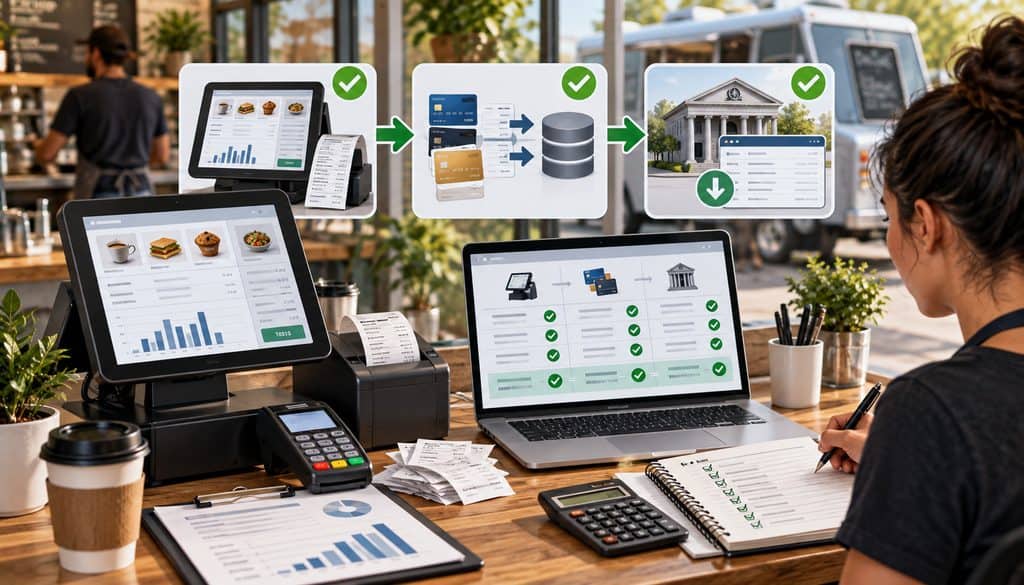
Matching deposits to daily sales should be a three-source process:
POS day report → processor batch report → bank funding.
Skipping the processor layer creates most of the confusion.
The POS establishes what the truck recorded as business activity. The processor establishes what card transactions were actually captured, adjusted, and funded. The bank confirms the final cash movement.
What to Capture From the POS
Many restaurant systems use the term Z-report, closeout report, sales summary, or end-of-day report.
The label matters less than the information.
For each festival day, capture at minimum:
- gross sales,
- card tender total,
- cash sales,
- tips,
- refunds,
- voids,
- taxes,
- order count,
- location or truck identifier where available,
- and any offline-payment indicators.
Toast, for example, currently uses Close Out Day and Z Report terminology and distinguishes closeout activity from payment capture.
Another POS may use completely different terminology.
What to Capture From the Processor Batch Report
For every batch associated with the festival, look for:
- batch ID,
- sales or transaction date,
- capture or settlement date,
- gross card amount,
- refunds,
- other adjustments,
- processing fees if deducted,
- holds or withholdings,
- net settlement,
- and payout or funding date.
The batch ID is especially important.
A processor-side settlement report should make that bridge visible. For example, Toast’s Settled Deposits Daily Breakdown and related payment reports can show settled date, sales date, payments, refunds, fees, other withholdings, and net deposits, with transaction-level detail available for individual batches.
The exact report names will differ by processor, but this is the type of information a food truck should confirm it can retrieve before festival season.
If a manager says, “Saturday seems $700 short,” that description leaves too many possibilities.
A better investigation begins:
Saturday POS card tender = $7,240.
Processor batch SAT-102 = $6,590.
$650 of transactions were uploaded later in batch SUN-104.
Now the variance has an operational explanation.
What the Bank Deposit Proves
The bank record shows cash movement.
It does not prove the original POS sales total.
That is why matching deposits to daily sales should not jump directly from the POS Z-report to online banking.
The processor settlement or funding report is the bridge.
Table 3: POS vs Processor vs Bank Control
| Control | POS | Processor | Bank | Variance |
| Friday card tender | $4,000 | $4,000 batch gross | — | $0 |
| Refunds | $0 | −$50 | — | Explained |
| Processor fees | Not in card sales | −$105 | — | Explained |
| Hold | Not in sales report | −$250 | — | Explained |
| Expected Friday-related funding | — | $3,595 | $3,595 | $0 |
Again, these are illustrative numbers.
Per-Day Festival Reconciliation Workflow
Use the same workflow for each day instead of trying to reconcile the whole event in one calculation.
- Pull the Friday POS closing report.
- Pull the processor batch or batches associated with Friday activity.
- Match the POS card tender total to captured card activity.
- Identify tips and any reporting differences.
- Identify refunds or void-related adjustments.
- Identify processor fees, withholdings, or holds.
- Calculate the expected deposit for the applicable settlement.
- Repeat the process for Saturday.
- Repeat the process for Sunday.
- Match each processor funding transaction with the bank.
- Investigate only the variance that remains after all known timing and adjustment items are documented.
This is the core control behind food truck festival sales reconciliation.
Event Organizer Commission for Vendors: Calculating the Cut
The phrase event organizer commission vendors sometimes appears simple: sell food, multiply sales by an agreed percentage, and pay the organizer.
In practice, the difficult part is defining the sales base.
Festival agreements may use several structures, including:
- a flat booth fee,
- a fixed rental charge plus other event fees,
- a percentage of defined sales,
- a percentage that applies only to particular categories,
- a processor-facilitated deduction,
- a centralized event-payment settlement,
- or a post-event invoice.
Do not assume the organizer’s commission is a processing fee merely because both reduce event profitability.
Organizer commission = contractual event expense.
Processor fee = payment-acceptance expense.
Keeping those separate makes both bookkeeping and contract verification easier.
Organizer Revenue Share Must Come From the Contract
For event organizer commission vendors, the written agreement should answer questions such as:
- What percentage applies?
- What number is the percentage calculated against?
- Does the definition use gross sales, net sales, or another term?
- Are sales taxes excluded?
- Are tips excluded?
- How are refunds treated?
- Are cash sales included?
- Are pre-orders included?
- Are discounts deducted before the commission base is calculated?
- When is payment due?
- What supporting report does the organizer require?
Never calculate the organizer’s percentage from memory after a busy weekend.
Use the signed agreement and the corresponding POS report.
Table 4: Illustrative Organizer Commission Calculation
| Contract Component | Calculation Basis | Illustrative Amount | Verification |
| Event sales reported by POS | Agreement-defined sales | $16,000 | POS event report |
| Sales tax exclusion | Only if contract excludes it | −$900 | POS tax report + contract |
| Defined commission base | Contract calculation | $15,100 | Recalculate |
| Organizer rate | Per signed agreement | Illustrative only | Vendor agreement |
| Organizer cut | Rate × commission base | Calculated amount | Settlement statement |
The commission rate is intentionally omitted because there is no universal festival percentage.
If the organizer withholds its percentage directly from vendor settlement, request an event settlement statement showing the sales base, percentage, adjustments, and amount withheld.
That document belongs in the same closeout folder as processor settlement records.
Festival Vendor Fees Accounting
Festival vendor fees accounting should separate distinct charges rather than collapsing everything into “festival fees.”
Potential categories include:
- booth rental,
- percentage commission,
- electricity fee,
- permit-related event fee,
- cleaning fee,
- equipment or utility charge,
- and processor-related event fee.
The appropriate general-ledger or tax treatment depends on the business and circumstances, so this article does not prescribe a universal classification.
Operationally, however, separate categories make the economics of an event much easier to understand.
If $1,200 left the business because of the organizer and $420 because of card acceptance, those costs answer different management questions even though both affect profit.
Cash Sales Need Separate Reconciliation
Cash should not be mixed into processor funding reconciliation because the processor never deposited it.
Reconcile cash independently:
POS cash sales → expected cash on hand → cash-count adjustments → bank cash deposit where applicable.
The organizer’s contract may nevertheless define the commission base to include cash sales.
That is another reason organizer reconciliation and processor reconciliation should be separate workpapers.
Sales Tax and Organizer Percentages
Sales tax collected from customers should not automatically be treated as operating revenue.
At the same time, you cannot assume an organizer’s percentage excludes tax.
Some agreements define the commission base one way; others define it differently.
Festival vendor fees accounting should therefore preserve both the POS tax amount and the contract definition used to calculate the event charge.
Offline-Queued Transactions and Delayed Festival Funding
Offline card activity is one of the strongest reasons festival closeout differs from an ordinary restaurant day.
Large festivals can overload cellular networks. Vendor Wi-Fi may fail. A truck may move to a part of the venue where signal quality changes.
Depending on the POS and merchant configuration, the system may allow card payments to be accepted while connectivity is unavailable.
Those payments can create a gap between the time food was sold and the time the transaction reaches the processor.
Offline activity can temporarily create a real gap between POS activity and processor reporting. Toast states that reports do not include data from offline devices until those devices reconnect and sync, and that payment capture can wait for stored transactions to transmit after connectivity returns. That means a festival sale can belong operationally to one event day while appearing in processor reporting later.
Clover likewise documents offline-payment functionality and notes that a device cannot perform its ordinary online card-validity and funds checks while disconnected.
These are platform examples, not universal behavior.
Check the settings, limits, eligible payment types, upload process, and risk rules for the specific equipment your truck uses.
The broader operational issue is the same:
transaction time and settlement time can diverge.
A food truck with recurring connectivity issues should also review how its offline payment workflow handles queued card transactions and post-event synchronization before the next festival.
Why Sunday Sales Can Appear Later
Suppose your truck loses connectivity Sunday evening.
Customers continue ordering and eligible transactions are stored according to your system’s offline process.
The device reconnects Monday morning.
Those transactions may then upload, receive their final processing status, and enter a later settlement cycle than the rest of Sunday’s activity.
That sequence can produce what looks like:
Sunday POS total: $5,000
Sunday-associated processor batch: $4,300
Apparent shortage: $700
If a later batch contains $700 of Sunday offline payments, nothing was necessarily missing. The timing simply moved.
This is another reason the food truck festival sales reconciliation file needs an offline-transaction log.
What an Offline Transaction Report Should Tell You
Where the platform supports it, identify:
- transaction time,
- order number,
- device,
- offline status,
- upload or synchronization time,
- associated batch,
- and final authorization or settlement status.
Not every queued transaction is guaranteed to fund.
A transaction accepted while the terminal cannot communicate with the processor may fail later depending on platform rules, card status, risk controls, or other circumstances.
Operators should therefore avoid recording every queued payment as unquestionably collectible cash before synchronization has completed.
What to Do When a Festival Deposit Is Short
A short-looking deposit should trigger a sequence of tests, not an immediate accusation that the processor lost money.
The best diagnostic order is:
- Wrong funding-date assumption?
- Missing or late batch?
- Offline transaction queue?
- Refund?
- Processor fee deduction?
- Organizer withholding?
- Hold or reserve?
- Chargeback or other adjustment?
- Genuine unexplained processor variance?
Following that order keeps food truck festival sales reconciliation focused on evidence.
Table 5: Short-Deposit Diagnostics
| Possible Cause | Evidence to Check | Next Step |
| Funding-date assumption | Settlement calendar and payout report | Wait for applicable settlement cycle if documented |
| Missing batch | POS closeout and processor batch list | Confirm batch status |
| Offline queue | Device/offline transaction log | Confirm upload and final status |
| Refund | Refund report | Match refund to order |
| Processing fee | Fee or payout detail | Verify contractual fee treatment |
| Organizer deduction | Vendor settlement statement | Recalculate contract formula |
| Hold/reserve | Processor notice or reserve report | Track held amount separately |
| Chargeback/adjustment | Dispute or adjustment report | Match to original transaction |
| Unexplained variance | Batch, payout, bank records | Escalate to processor |
Missing Batch
A genuinely missing batch deserves immediate attention.
Possible operational causes include an incomplete close, a device that remained offline, a terminal that failed to upload, or a capture process that did not complete as expected.
Do not try to solve the problem by repeatedly initiating manual capture unless your processor specifically directs you to do so.
Instead, verify batch status first.
Current Toast guidance, for example, warns merchants against manually triggering capture after an outage while authorizations are still synchronizing because doing so can create deposit discrepancies.
Held Funds
If the processor report specifically shows a hold, reserve, withholding, or equivalent category, preserve that label in your reconciliation.
A $500 hold explains why today’s bank deposit is $500 lower.
It does not necessarily mean the event lost $500.
Track the release or other final disposition separately.
Fee Error
A processor fee can be a valid deduction and still be incorrectly calculated.
If the amount does not match the relevant merchant agreement or processor statement, document the variance and escalate it.
When contacting processor support, provide enough information to identify the settlement without transmitting unnecessary cardholder data.
A useful support packet includes:
- merchant ID,
- batch ID,
- event or transaction date,
- batch gross amount,
- expected funding,
- actual funding,
- relevant transaction report,
- settlement report,
- and bank reference or posting information.
That is much more actionable than saying, “My festival deposit is short.”
A Reusable Three-Day Event Reconciliation Template
The easiest way to make matching deposits to daily sales repeatable is to use the same worksheet for every festival.
Start with a simple three-column control.
Simple Three-Column Reconciliation
| Source / Adjustment | Expected Amount | Actual / Bank Amount |
| POS card sales | ||
| Tips included in processor payment | ||
| Refunds | ||
| Processor fees deducted | ||
| Organizer cut deducted | ||
| Holds/reserves | ||
| Expected processor deposit | ||
| Actual bank deposit | ||
| Remaining variance |
The spreadsheet should retain the supporting batch IDs rather than becoming a standalone summary with no audit trail.
Three-Day Worked Example
Assume a truck records these hypothetical base card sales:
- Friday: $4,000
- Saturday: $7,000
- Sunday: $5,000
Total: $16,000.
Now introduce realistic festival complications.
Friday has a $50 refund and $105 of processing fees deducted from settlement.
Saturday has $180 of processing fees and a $300 processor hold.
Sunday has $125 of fees, but $600 of Sunday’s card activity was captured offline and uploads into a later batch.
The event organizer is also owed a contractually calculated commission of $900. Assume for this example that the organizer invoices the vendor separately rather than deducting the commission from card settlement.
The truck should not subtract that $900 from expected processor deposits because the processor did not withhold it.
That is an important distinction.
Table 6: Three-Day Festival Reconciliation
| Line Item | Friday | Saturday | Sunday | Total |
| POS card sales | $4,000 | $7,000 | $5,000 | $16,000 |
| Tips tracked separately | $320 | $560 | $400 | $1,280 |
| Refunds | −$50 | $0 | $0 | −$50 |
| Batch gross currently submitted | $4,270 | $7,560 | $4,800 | $16,630 |
| Delayed offline amount | $0 | $0 | $600 | $600 |
| Processor fees deducted | −$105 | −$180 | −$125 | −$410 |
| Organizer commission deducted by processor | $0 | $0 | $0 | $0 |
| Holds/reserves | $0 | −$300 | $0 | −$300 |
| Expected current-cycle funding | $4,165 | $7,080 | $4,675 | $15,920 |
| Later offline-related funding | $0 | $0 | $600 less applicable adjustments | Separate batch |
| Actual bank deposit | Enter actual | Enter actual | Enter actual | |
| Variance | Calculate | Calculate | Calculate |
This example intentionally distinguishes card sales from tips and leaves the eventual offline amount subject to its actual processor status and applicable fees.
The $900 organizer commission belongs in the event profitability and organizer-payable reconciliation, not in the processor funding calculation, because in this scenario it was invoiced separately.
If the event’s payment platform had withheld that amount before paying the vendor, it would instead appear as a settlement deduction supported by the organizer statement.
That is the difference between good festival vendor fees accounting and simply forcing every expense into the processor column.
Processor Clearing Account
A processor clearing account can make this structure easier to maintain.
At a high level:
POS card transaction → processor clearing → fees/holds/refunds/adjustments → bank.
The clearing balance represents activity recorded as card payments but not yet fully converted into bank cash.
That is especially useful when weekend batches remain unsettled Monday morning.
Organizer commissions normally remain separate unless the event’s payment arrangement actually deducts them from vendor settlement.
Exact account names and accounting treatment should be established with the business’s bookkeeping or accounting professionals.
Which Processor Reports to Pull Before Festival Season
A strong food truck festival sales reconciliation process starts before the first customer arrives.
Ask the processor or POS provider whether your account provides access to:
- transaction-level payment reports,
- batch reports,
- settlement or payout reports,
- fee detail,
- refund reports,
- chargeback or dispute reports,
- hold/reserve/withholding reports where applicable,
- offline-transaction status reporting where available,
- and monthly merchant statements.
Do not merely confirm that the reports exist.
Confirm that the employee who will perform festival closeout can actually access them.
Many systems use role-based permissions. It is much safer to give finance or management personnel appropriate individual access than to share the owner’s administrator password.
Also test export functionality.
Download a sample batch before festival season and verify that the report contains the identifiers your team needs.
Daily Festival Close Routine
At the end of every event day:
- Close the POS business day according to your platform procedures.
- Export or save the day’s Z-report or equivalent closeout report.
- Confirm the relevant card batch status.
- Save the batch ID.
- Record any known offline transactions or connectivity incidents.
- Record the organizer-relevant sales number required by the contract.
- Back up the reports.
- Repeat the process the next day.
A truck already using POS reporting to separate sales, payment types, and operating activity has a better starting point than one reconstructing everything from bank deposits after the fact.
Do not wait until Monday.
A failed batch close is much easier to investigate Saturday night while the devices, staff, receipts, and event context are still available.
Festival Closeout Folder
Keep one digital folder per event containing:
- vendor agreement,
- Friday POS report,
- Saturday POS report,
- Sunday POS report,
- batch reports,
- processor funding reports,
- organizer settlement or invoice,
- bank records,
- refund log,
- fee detail,
- hold/reserve documentation,
- and reconciliation worksheet.
For multi-truck operators, include the truck or location identifier in filenames.
The same principle applies to event tags inside the POS.
Useful identifiers include:
Festival name + truck + event day + location.
Those tags make later food truck bookkeeping significantly easier.
Common Festival Reconciliation Mistakes
Festival closeouts usually become confusing because different records are mixed together too early.
Table 7: Common Festival Reconciliation Mistakes
| Mistake | False Variance Created | Better Approach |
| Comparing weekend gross sales directly with Monday’s deposit | Timing and deductions look like missing money | Reconcile each batch to its payout |
| Ignoring batch cutoff | Late transactions seem missing | Compare POS business day with processor batch |
| Ignoring tips | Processor gross appears too high | Separate tips from operating sales |
| Forgetting offline payments | POS and batch totals differ | Track synchronization and later batches |
| Treating organizer cut as processor fee | Event and payment costs become mixed | Record each expense separately |
| Ignoring holds | Temporary delayed funding looks lost | Track hold/reserve balance |
| Failing to save daily reports | Weekend activity must be reconstructed | Save each closeout daily |
| Combining cash and card | Processor settlement cannot tie | Reconcile cash independently |
| Ignoring later refunds/chargebacks | Future payouts appear unexpectedly short | Link adjustments to original event |
| Reconciling only by date | Cutoffs shift transactions | Use batch IDs |
Multiple Terminals and Readers
A truck operating three handhelds should make sure every device’s activity ultimately appears in the event total.
Do not assume that because two devices reconciled, the third did too.
If each reader feeds the same merchant batch, confirm device-level totals before accepting the combined figure.
If they use separate merchant accounts or MIDs, reconcile each account independently before combining event results.
Multiple Trucks
Multi-truck operators should avoid consolidating too early.
Reconcile:
truck → day → processor/MID → batch → deposit
before producing a company-wide festival summary.
Otherwise a surplus in Truck A’s worksheet can accidentally mask a shortage in Truck B.
Centralized Festival Payment Systems
Some festivals use arrangements in which the organizer or another platform collects customer payments and later settles with vendors.
In that situation, first determine who is acting as the merchant of record and how vendor settlement is calculated.
The food truck may not own the underlying processor deposit.
If the organizer collects funds and pays the vendor net of commission or other contractual items, reconcile the organizer’s settlement statement to the POS or event-sales source specified in the vendor agreement.
Do not force that structure into a conventional merchant-account reconciliation when the actual payment flow is different.
Multi-Day Festival Sales Reconciliation Checklist
Use this checklist as the operational closeout for food truck festival sales reconciliation:
- Save the festival or vendor agreement.
- Confirm the organizer fee structure.
- Confirm the processor settlement schedule.
- Confirm the batch cutoff.
- Confirm weekend funding behavior.
- Confirm offline-payment behavior.
- Confirm report access.
- Tag festival, day, and truck in the POS.
- Save the Friday Z-report or equivalent.
- Save the Friday batch ID.
- Save the Saturday Z-report.
- Save the Saturday batch ID.
- Save the Sunday Z-report.
- Save the Sunday batch ID.
- Pull the processor settlement report.
- Pull processor fee detail.
- Pull hold/reserve information where relevant.
- Identify offline transactions.
- Identify refunds.
- Identify tips.
- Calculate the organizer commission from the written agreement.
- Calculate expected net processor funding.
- Match processor deposits to the bank.
- Investigate any remaining variance.
- Post organizer expenses separately from merchant-processing expenses.
- Reconcile the processor clearing account where used.
- Save event closeout workpapers.
- Monitor later refunds and chargebacks.
For operators attending large events frequently, reliable mobile connectivity and backup payment processes reduce the number of offline exceptions that have to be reconstructed later.
Practical 25-Step Festival Reconciliation Workflow
For a repeatable food truck festival sales reconciliation process, use the following order:
- Save the signed vendor agreement.
- Identify the organizer’s commission formula.
- Verify whether cash, tips, taxes, pre-orders, or other categories affect the commission base.
- Confirm the processor’s actual funding schedule.
- Confirm the batch cutoff.
- Confirm the POS’s business-day settings.
- Confirm offline-payment behavior.
- Confirm required staff can access reports.
- Tag transactions by festival, truck, and location where supported.
- Save Friday’s POS closeout.
- Record Friday’s batch ID.
- Repeat the process Saturday.
- Repeat the process Sunday.
- Pull all settlement or payout reports once batches are available.
- Match each POS day to its processor batch or batches.
- Identify transactions uploaded from an offline queue.
- Identify refunds.
- Identify processing fees deducted from each payout.
- Identify organizer deductions actually withheld from settlement.
- Identify processor holds, reserves, or other documented withholdings.
- Calculate expected funding by batch.
- Match each funding transaction with the bank.
- Investigate the remaining unexplained variance.
- Reconcile organizer expenses and processor clearing separately.
- Save the event workpapers and monitor later refunds or disputes.
That sequence prevents one of the most damaging festival-accounting habits: changing the numbers until the bank happens to match.
Every difference should have an explanation.
Frequently Asked Questions
How do I reconcile food truck sales after a festival?
Start with each event day’s POS closeout, then match the card tender total to the processor batch or batches associated with that activity. Reconcile refunds, fees, tips, holds, offline transactions, and any documented settlement deductions before matching expected processor funding to the bank. That day-and-batch approach is the foundation of food truck festival sales reconciliation.
Why do my weekend card sales not equal Monday’s deposit?
The deposit may represent only some of the weekend batches. Other sales may still be awaiting settlement, while fees, refunds, holds, offline uploads, or other documented adjustments may change the amount. Do not treat Monday as the automatic funding date for every Friday-Sunday transaction.
How does batch settlement work for a food truck?
In a batch settlement food truck workflow, card payments are authorized during service and later captured or grouped for settlement according to the POS and processor configuration.
The processor then funds settled activity according to the account’s applicable schedule. Authorization, capture, settlement, payout, and bank posting should not automatically be treated as one event.
Do Friday, Saturday, and Sunday sales fund separately?
They may, but there is no universal rule.
Separate days can generate separate batches, multiple batches can sometimes relate to one service day, and offline transactions or cutoffs can move activity into later settlement cycles. Verify the actual funding behavior for your processor and account.
What is the difference between a POS Z-report and processor batch report?
The POS Z-report or equivalent describes business activity recorded by the truck, such as sales, card tenders, cash, tips, taxes, refunds, and order counts. The processor batch report describes card-payment activity submitted or settled. The two should be reconciled but should not be assumed to be interchangeable.
How do I match deposits to daily food truck sales?
For matching deposits to daily sales, use three records:
POS report → processor batch/settlement report → bank deposit. Match the POS card tender to processor transactions first. Then reconcile deductions and timing before comparing the resulting payout with the bank.
Do processor fees come out before the deposit?
Sometimes.
Some accounts receive net funding with applicable fees deducted from payouts. Others may have fees collected separately or periodically. Review your processor’s settlement report and merchant agreement rather than assuming one fee model.
How should tips be handled when reconciling festival sales?
Separate tips from operating sales in the bookkeeping even when the processor settles the customer’s entire card payment together. Also check the vendor agreement before deciding whether tips are included in the organizer’s commission base.
How do event organizer commissions for vendors work?
Event organizer commission vendors arrangements can use a flat fee, percentage formula, centralized settlement deduction, post-event invoice, or combination of charges. The written agreement should define the calculation base, rate, excluded categories, refunds, payment timing, and required sales reports.
Is a booth percentage the same as a processor fee?
No.
A booth percentage or festival commission arises from the vendor’s event agreement. A processor fee arises from accepting and processing electronic payments. For clean festival vendor fees accounting, keep those costs separately identifiable.
How do offline transactions affect festival reconciliation?
Eligible offline transactions can be recorded on a device and uploaded after connectivity returns, depending on the POS and configuration. That can move the transaction into a later batch and delay its appearance in processor reports. Offline acceptance also does not necessarily guarantee successful funding.
What should I do if a festival deposit is short?
First test the settlement date, batch status, offline queue, refunds, processing fees, organizer deductions, holds, and chargeback or adjustment activity. Only after those items are reconciled should the card sales vs bank deposit difference be treated as unexplained and escalated.
What processor reports should I download before festival season?
At minimum, confirm access to transaction, batch, settlement or payout, fee, refund, dispute, monthly statement, and hold/reserve reports where applicable. Also determine whether your POS provides an offline-transaction or synchronization-status report.
How should refunds after the festival be reconciled?
Record the refund as a later adjustment and, where possible, link it to the original event transaction. If the refund reduces a future payout, do not reopen the original festival settlement and incorrectly conclude that the first deposit was short.
What records should I keep after a multi-day event?
Keep the vendor agreement, POS day reports, processor batches, funding reports, organizer settlement, bank records, fee detail, refund documentation, offline-transaction notes, and reconciliation worksheet. Those documents provide the audit trail needed if later refunds, chargebacks, processor adjustments, or organizer questions arise.
Conclusion
Multi-day festivals should be reconciled by event day and processor batch rather than by comparing the entire weekend’s sales with the first bank deposit that appears afterward.
A reliable food truck festival sales reconciliation recognizes that the POS sales date, business day, batch date, settlement date, funding date, and bank-posting date are not necessarily identical.
Start with the POS record of customer activity. Match card tenders to processor batches. Then account for documented tips, refunds, processing fees, organizer deductions, holds, reserves, and other adjustments before calculating expected processor funding.
Offline transactions deserve particular attention because connectivity problems can move festival sales into later batches. A Sunday transaction can still belong to Sunday’s operating results while reaching the processor on another date.
Organizer percentages should also be calculated from the written vendor agreement rather than memory, assumptions, or a bank deposit.
Most importantly, do not call a deposit “missing” merely because it does not equal gross sales. A deposit becomes genuinely unexplained only after batch timing, offline activity, fees, refunds, holds, organizer deductions, and other documented settlement items have been fully reconciled.